Showing posts with label Crafts. Show all posts

Monday, January 19, 2015

Pallet Bed

Ohh I really like this!!!
DIY PALLET SWING BED I will have this in my yard someday

Really, who needs or even wants a hammock anymore if you can have this? Clearly, living in a city or an apartment, this is just not doable, but, I’m sure there is a way to make it somewhat possible.

At http://diy-creator.com/2014/02/14/diy-pallet-swing-bed-better-than-hammock/ you can learn how to turn old pallets into a fun and I’d imagine, super comfy outdoor “chill” area.

Depending on your size, or how many people you actually expect to be sitting on this at once, I’d think you’d only need 2, maybe 3 pallets. Living in an a smaller home with not a big back yard, I’d probably just go for pallets that are large enough to use a matress the size of a toddler bed, and trust me, that bia would be mine and mine alone! Just something to actually read or write on and actually relax on!

All you need is the pallets, a mattress, and some nice, tough, and sturdy ropes to tie the pallets up to. Mind you, you need to make sure that it can secure your weight. But hey, we all know that that “weight limit” can change in a minute, so please, give yourself a little extra strength behind it.
/

Sunday, July 08, 2012

Food Face...

Fun with food and sharp knives!

Take a couple of tomatoes, hard-boiled eggs, black olives, some fresh greens, and voila!


How cute is this?


The horns, eyes and spots are cut from black olives.


Wednesday, June 27, 2012

Terra Cotta Flower Pots

Take your old terra cotta flower pots ~ paint wash them.. Add a bit of water your paint, and have fun while you give the pots a new look.....


Monday, March 26, 2012

Bean Bag

Rollie Pollie!

Looking for hours of entertainment? Another great craft site...
Meet, The Rollie Pollie:
It’s a chair, it’s a toy, it’s your favorite pillow.
Made of durable cotton twill or soft vinyl, each bag is actually a slip cover (with another Rollie Pollie inside) then filled with mounds and mounds of soft cluster stuffing. So if it gets dirty, just zip it off and throw it in the wash. And with a handle on top, it’s easy to toss around. Ready for a pillow fight? We’ll let dad referee.
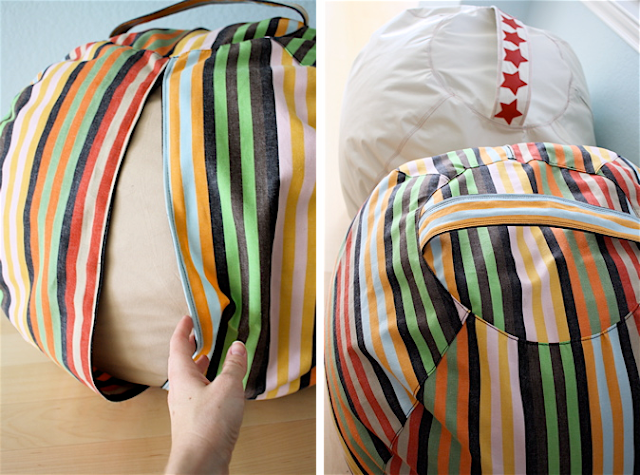
This is a MINI-Tutorial for the Rollie Pollie, showing the basics of how to make one.
The Full, Detailed pattern can be found at the MADE SHOP.
The detailed pattern includes:
Tons of info about Fabric selection, sewing with zippers, where to buy the right filling for your Rollie Pollie, How-to make an Insert Rollie Pollie and a slip-cover to go over it (easy to wash), and TWO different sizes of Pattern Pieces, which can be printed right on your home printer!
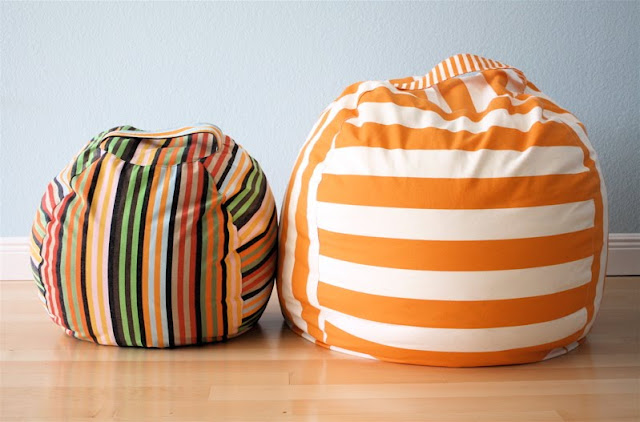
In this mini-tutorial, we’ll show you how to make the Insert Rollie Pollie.
Okay, let’s get started!
The Rollie Pollie is made of two pattern pieces (shown in the drawing below). You will need FOUR of the SIDE pieces, and TWO of the Top and Bottom circles. If you’d like to add a handle, cut a rectangle about 1-inch longer than the circumference of your circle piece and about 3 inches wide.
If you want to make a slip-covered Rollie Pollie (by adding a zipper), you will need to make ONE of the SIDE pieces, 1-inch wider in the middle to accommodate the extra zipper seam.
Create your pattern pieces on a large piece of paper or on a piece of junk fabric. Then with a fabric Marker or Sharpie, trace your pattern pieces on to your fabric. Depending on your pattern size and the width of your fabric, you will need anywhere from 2-4 yards of fabric. For the insert Rollie Pollie, it’s best to use white fabric (so it doesn’t show through the outside slip cover). Twill and heavier cottons work best:
Once your pieces are cut out, place two of the SIDE pieces back to back, pin all the way down ONE side:
and sew down that side:
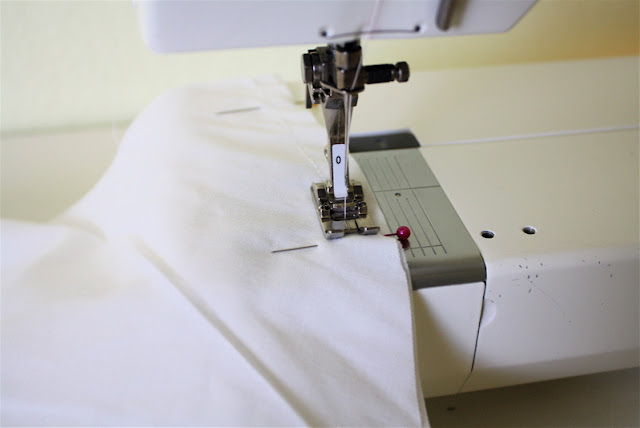
This next step is not necessary, but it will make your Rollie Pollie stronger. Serge off your seams. If you don’t have a serger, do a zigzag or leave the edges raw:
Repeat the above steps, attaching all your SIDE pieces to each other. When you get to the last SIDE, YOU NEED TO LEAVE AN OPENING IN THE SIDE so that you can get the stuffing inside. I like to mark my start and stop points with pins, so I don’t forget to leave an opening:
Then with all of your sides sewn together, place your Circle pieces on the top and bottom of your Rollie Pollie. Pin them down, sew all the way around, and you’re almost done!
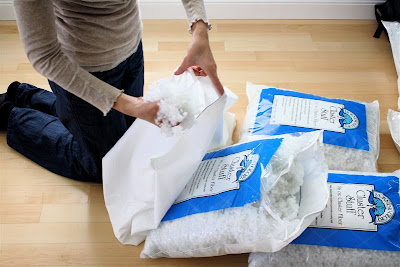
Turn the Rollie Pollie inside out and fill it with stuffing. I chose CLUSTER STUFF, found at Walmart. (The Rollie Pollie Pattern has more detailed info about all stuffing options).
Fill it as full as you like. You want it to have a little give. But the stuffing will also smush over time, so get a lot in there.
Pin the opening shut:
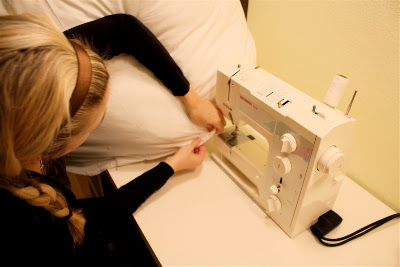
And though this is bulky to do, sew the opening shut with your machine. It doesn’t need to look pretty because it will be inside the slip cover. Just make sure it’s sewn SHUT!
Stick the Insert into your slip cover and……
You’re done!
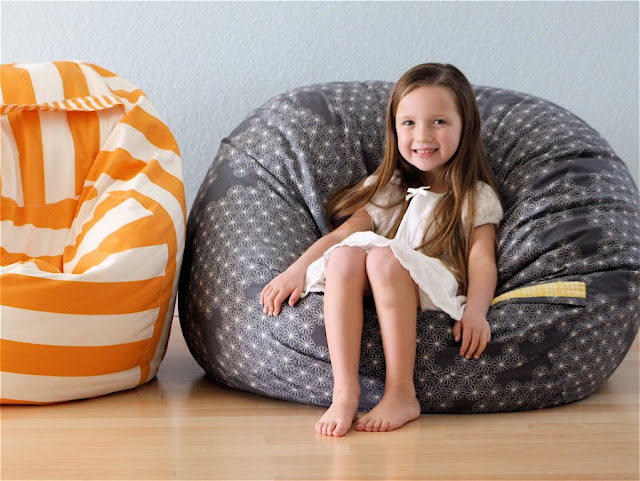
Fore more detailed info and helpful tips, please see The Rollie Pollie Pattern at MADE.

Kid Crafts

Look what I found when searching the web for 'Spring Crafts'...  Such a cute craft for those little hands! I can't wait to try this with all my grandbabies!!~


Paper plate crafts
Enchanted Learning Software's
Duck Paper Plate Craft
More Kinder Crafts This easy-to-make duck is a cute craft that is made from a single paper plate and construction paper.

More animal crafts
Supplies needed:
  • Paper plate
  • Scissors
  • Glue
  • Stapler
  • A pencil
  • Yellow and orange construction paper or oak tag
  • Crayons, paint or markers
  • Googly eyes (optional)
Trace your hands on yellow construction paper, then cut the hands out. If you don't have yellow construction paper, use stiff white paper, then paint it yellow (or use markers).
Fold a paper plate in half. Paint it yellow and let it dry
Staple the hands near the fold on one end - these will be the tail feathers.
Using yellow construction paper or oaktag, cut out a circle (about 3 inches across or a little bigger) -- this will be the duck's head. Using orange construction paper or oaktag, cut out an elongated oval with one end cut off -- this will be the duck's bill. Fold the end of the beak over, making a small tab (this is where you will put the glue).
Glue the bill onto the circle (put the glue on the small tab that will be folded under the bill). Draw eyes above the bill (or glue on small googly eyes). Staple the head to the paper plate (near the fold line, opposite the tail feathers).
Using orange construction paper or oak-tag, cut out the duck's feet - they should be connected by a short strip of paper. To draw each foot, start with an oval, then draw a zigzag on one end. Fold the paper where the feet meet the strip of paper.
Staple each foot to the bottom of one side of the paper plate, right inside the fold line of the foot. You now have a cute duckie that will stand up.
For a duck theme page, click here.

Sunday, February 26, 2012

FOOD LABELS


MAGIC Decal Transfer Tutorial with Free Printables!


Magic decal coating paper is a complimentary product designed to be used in conjunction with standard decal paper to make the finished transfers durable - yes, even dishwasher safe!

If you're already familiar with magic decal coating paper then please excuse my tardy excitement, though for everyone else who is just getting to the party now too, feel free to start throwing the streamers!

As there are probably several brands of magic decal coating paper out there, each with slightly differing application requirements, for clarity in this tutorial I will specifically pertain to the particular product I used which I got from here....


The paper I received came with one sheet of water slide decal paper (distinguished by a blue watermark on the back) which you print your image onto and one sheet of the magic coating paper (distinguished by attached translucent protective paper).

GATHER YOUR SUPPLIES
1. Image to transfer
Use anything you like.
I made up my canister labels in Photoshop. I wanted them to be a bit different and quite typographic so decided to style them based on dictionary definitions (my artwork is attached as a free printable if you would like to use them!)
2. Inkjet printer
3. Decal paper (blue watermark on back)
Decal paper comes in clear or white. I'm using the clear paper because I want a transparent background around my image.
4. Magic paper (attached translucent protective paper)
5. Laminator
Basic laminators can be bought for around $20 from most office supply and department stores.
6.Scissors
7. Water
8. Soft cloth
9. Item to embellish
10. Microwave, oven or hairdryer

THE PROCESS

1. Print your image onto the glossy side of your decal paper (DO NOT mirror your image) using an inkjet printer. Allow to dry thoroughly.
I created my canister labels in Photoshop and have attached them below as a free printable if you would like to use them.

2. Separate the translucent protective paper from the magic paper. Do not throw the translucent paper away.

3. Place the magic paper gloss side up on your table. Lay the decal paper printed side down on top of the magic paper. Place the translucent protective paper gloss side down on top of the decal paper.
As my image took up the entire sheet of decal paper I did not need to trim around it first. If you are working with a smaller image you may wish to cut roughly around it with scissors.


4. Laminate your stack of three papers together on low speed and at low temperature.
Like I said, basic laminators can be bought for around $20 from most office supply and department stores.

5. Discard the translucent paper. Your decal paper and magic paper should now be fused together. Trim closely around your image - you can see it quite easily through the paper if you hold it up to the light.

Where there is no ink, the decal will leave a very fine, slightly translucent film which is visible close up or on certain angles. As my image is text alone with no border I experimented with techniques and found the neatest finish to be a nice even box (trying to mimic the outline of the text just looked messy). If your image has a distinct border then trim approximately 2mm all the way around it (leaving a small buffer ensures you get a good seal).


6. Dampen the back of the decal paper (watermarked side) with a cloth until it becomes translucent. Wait around 15 seconds then gently peel the paper away completely.
Important: ensure you remove the watermarked decal paper only at this stage.

7. Quickly immerse the decal in a shallow dish of water to dampen the other side then position it, image side down, on your item, smoothing it down with your fingers and a slightly damp cloth to remove excess water.

8. Carefully slide off the backing paper and manipulate the decal into its exact position then continue to smooth it until it is water and air bubble free (the image for step eight shows the transfer with some minor creases and bubbles. This is only because the photograph depicts the removal of the backing paper before I have smoothed the decal. Rest assured that it does flatten out completely).

9. Finally, set the decal by either:
- Baking in an electric oven for 8 minutes at 150 degrees Celsius
- Cooking in a microwave for 5 minutes on low
- Blowing with a hairdryer for 5 - 10 minutes


Although I was hesitant, I did find the courage to run these babies through the dishwasher - twice, just to be certain - and they didn't show any signs of distress. I was honestly AMAZED! Of course given I have only had them for a few day I can hardly vouch for their longevity so advise hand washing for frequent use.
As I mentioned, there is a very faint translucent background (which is the case with regular waterslide decals too) though once the canisters were full it was barely noticeable.

And here are your complimentary printables....
(simply click on the image to enlarge to full size then save it to your computer)


The Perfect ANYTIME Snack Blend

I enjoy making this yummy snack during Autumn. Makes a pretty table/counter display of Fall colors. The perfect treat blend for my little gr...